








What to Do About Cracked Firebricks
⏱️ Time to read:
Cracked firebricks are one of those things every stove owner notices eventually — usually mid-clean, mid-winter, or mid-“should I be worried about this?” moment.
The problem is, the advice out there swings between “it’s completely fine” and “your stove might explode”… which isn’t exactly helpful when you’re staring at a crack and trying to decide whether to ignore it or panic-buy replacements.
So let’s get down to what actually matters: what cracked firebricks mean, when they’re harmless, and when they’re a genuine problem you shouldn’t ignore.
🧠 Quick Answer: What are cracked firebricks and what should I do about them?
Cracked firebricks are a normal part of wood-burning stove wear and tear, and hairline cracks (under 3-4mm) don't require immediate replacement.
You must replace the firebrick if the crack is wider than 4mm, the brick is beginning to crumble, or the gap exposes the metal stove body behind it. Using a stove with exposed metal can cause permanent, dangerous damage.
Rule of thumb: If you can see metal behind the firebrick, stop using the stove immediately and replace the brick.
🔑 Key Takeaways
- Small cracks are normal wear, not failure: Hairline fractures happen naturally as the stove heats and cools.
- Replace if the brick is loose, crumbling, or exposing metal: Protecting the outer stove body is the priority.
- Rapid temperature changes are the main cause: Blasting a cold stove with a roaring fire causes thermal shock.
- Poor fuel accelerates damage: Wet wood or incorrect fuel types create uneven, damaging heat.
- Frequent cracking can signal stove inefficiency or ageing: If you are constantly replacing bricks, your stove may be over-firing or coming to the end of its lifespan.
📍 Jump to what matters
Short on time? Here’s when to ignore it — and when to replace it.
- Do Cracked Firebricks Need Replacing?
- What Are Firebricks (And Why Does Your Stove Need Them)?
- Why Firebricks Crack in a Stove
- Is a Cracked Firebrick Dangerous?
- When to Replace Firebricks
- Should You Stop Using Your Stove?
- How to Replace a Firebrick
- Cost of Replacing Firebricks
- How to Replace Firebricks
- When Cracked Firebricks Might Mean a Bigger Problem
- How to Prevent Cracked Firebricks
- Cracked Firebrick FAQs
Do Cracked Firebricks Need Replacing?
Cracked firebricks don't usually need replacing if the crack is small (under 3-4mm) and stable.
You must replace the brick if it becomes loose, starts crumbling, or exposes the metal stove body behind it. Not replacing it can lead to permanent stove damage.
The most common causes are thermal shock (heating the stove too quickly), impact from logs, over-firing, and general wear over time.
What Are Firebricks (And Why Does Your Stove Need Them)?
Firebricks are the protective inner lining in your stove’s firebox. They serve two vital purposes:
- Protection: They insulate the outer metal stove body from the fire's intense heat, which prevents the metal from warping, cracking, or melting.
- Efficiency: They reflect heat back into the firebox, making sure the fire burns hot enough to combust gases cleanly while pushing the warmth out into your room rather than up the chimney.
Most modern stoves use either vermiculite or clay/ceramic firebricks. Here's how they compare:
| Material | Primary Role | Characteristics |
|---|---|---|
| Vermiculite | High insulation & heat reflection | Lightweight, highly efficient, easy to cut, but more fragile. |
| Clay / Ceramic | Durability & heat retention | Heavy, takes longer to heat up, holds heat longer, highly durable. |
Why Firebricks Crack in a Stove
These are the most common causes of cracked firebricks:
- Thermal shock (rapid heating from cold)
- Impact damage from loading logs
- Over-firing the stove
- Natural wear over time
- Poor fuel quality
Thermal Shock (The Biggest Culprit)
Firebricks are designed to withstand extreme heat, but they hate sudden changes in temperature. Going from a freezing cold stove to a roaring, maximum-temperature fire in just a few minutes causes the moisture inside the bricks to expand too rapidly, snapping the material.
Poor Fuel Quality
Burning wet, unseasoned wood causes your fire to smoulder and produce excess moisture, which degrades the bricks over time.
Similarly, using the wrong type of fuel for your stove (like burning smokeless fuel briquettes or household coal in a wood-only stove) causes localised, intense heat pockets that crack the lining.
Impact Damage
Firebricks are fragile — especially vermiculite ones. Throwing heavy logs into the firebox like you’re angry with them, or forcing oversized logs into a tight space, will easily crack or shatter the bricks upon impact.
Age & Normal Wear
Firebricks are consumable parts, which means they are not part of the permanent stove structure. Over the years (and hundreds of fires), they extract and contract — causing the material to degrade and lose its structural integrity.
Incorrect Stove Use
Over-firing your stove — leaving the air vents wide open for too long — pushes the temperature much further than the manufacturer’s safe limits. This completely bakes the moisture out of the bricks — leaving them brittle and prone to shattering.
💡 Worth knowing: Hairline cracks often look worse than they are. Firebricks can crack cleanly but still be structurally intact. If the surface is flush and nothing moves when you press it, it’s usually doing its job just fine.
Is a Cracked Firebrick Dangerous?

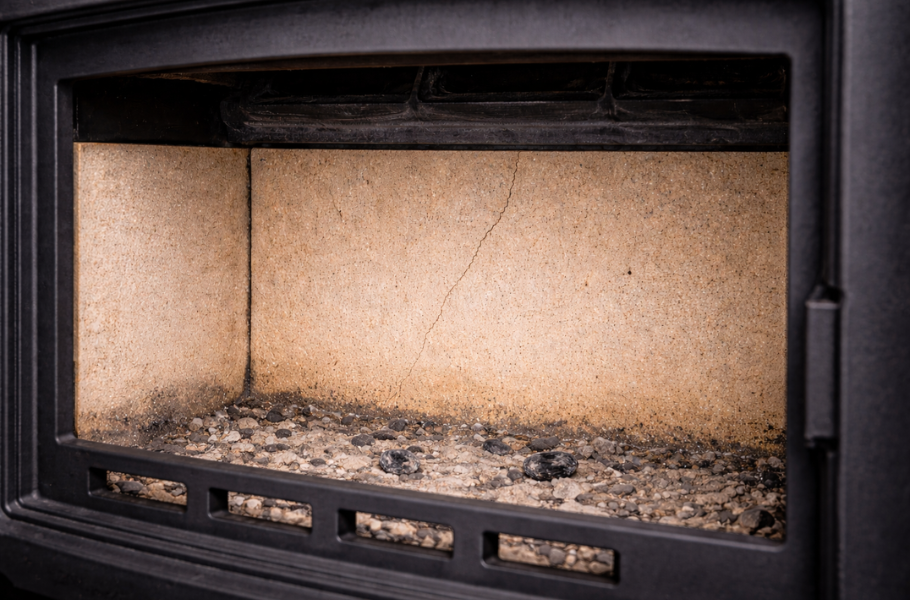
If you’ve just spotted a crack (like the one above), your first thought is usually: is this actually dangerous, or am I overthinking it?
The answer depends on how severe the crack is and whether the brick is still doing its job.
- Safe (monitor): Small hairline cracks (under ~3–4mm) where the brick is still intact, stable, and sitting flush against the stove wall.
- Needs replacing: Cracks that expose the metal stove body, bricks that are loose or shifting, or any sections that are crumbling.
If the metal body is exposed to direct flame, it can warp or crack — and that damage is usually irreversible, turning a cheap fix into a much bigger problem.
💡 Worth knowing: One cracked brick can stress the others. If a brick shifts or breaks badly, it can change how heat is distributed inside the firebox. That’s when you start seeing a domino effect of cracking elsewhere.
When to Replace Firebricks (And When You Can Leave It Alone)

Replace your firebricks if:
- ⚠️ They are crumbling or breaking apart
- ⚠️ They no longer sit securely in place
- ⚠️ The crack exposes the metal stove body
- ⚠️ The damage exceeds roughly 3–4mm or continues to worsen
Use this quick decision table to know exactly what to do with a cracked firebrick:
| Condition | Action Required |
|---|---|
| Hairline crack (under 3-4mm) | Monitor. Safe to use the stove as normal. |
| Larger crack (around 3–4mm), but stable | Usually fine but prepare for worsening. Monitor closely. |
| Expanding crack or loose pieces (3-4mm) | Plan replacement. Order spares before it fails. |
| Crumbling / gaps exposing metal (over ~4mm) | Replace ASAP. Do not use the stove until fixed. |
Should You Stop Using Your Stove?
You can continue using your stove with minor, stable cracks.
However, stop using it immediately if the brick is loose, crumbling, or exposing the metal stove body — this can cause permanent damage and become a safety risk.
How to Replace a Firebrick
Replacing a firebrick is usually a simple DIY job. Most modern stoves either allow tool-free removal or just need a screwdriver to take out the retaining baffle.
Basic steps:
- Clear out all ash from the firebox
- Remove the top baffle plate (this holds the bricks in place)
- Slide out the damaged brick
- Slide in the replacement
- Refit the baffle plate
Quick, low-cost fix — and well worth doing before it turns into a bigger problem.
⚠️ Always check your manufacturer’s manual for your specific model.
💡 Worth knowing: You don’t always need an exact manufacturer replacement. For many stoves, especially with vermiculite, you can cut replacement boards to size yourself. It’s often cheaper and quicker than sourcing branded parts.
Cost of Replacing Firebricks
Typical UK costs:
- £10–£40 per individual brick
- £50–£150+ for a full replacement set (depending on stove size and brand)
Replacing a single brick is inexpensive — but if you’re doing it often, it’s worth checking the overall condition of your stove.
When Cracked Firebricks Might Mean a Bigger Problem
Occasional cracks are normal. Replacing firebricks every single season isn’t.
If it’s happening regularly, there’s usually an underlying issue:
- Over-firing (running the stove too hot)
- Poor build quality
- An ageing stove starting to lose structural integrity
If you’re swapping bricks and other parts year after year, it’s worth stepping back — upgrading to a modern, Ecodesign-compliant stove can often be more cost-effective long term.
👉 Time for a replacement?
If you’re constantly replacing parts, upgrading your stove can save money long term and improve efficiency. Browse our range of wood burning stoves.
How to Prevent Cracked Firebricks
How to make your firebricks last longer:
- Build fires gradually: Start with kindling and let the stove warm up slowly to avoid thermal shock
- Use the right fuel: Burn low-moisture, kiln-dried logs for a steady, controlled burn
- Don’t overload: Leave space in the firebox — don’t wedge logs against the sides
- Handle with care: Place logs gently using gloves or tongs, don’t throw them in
- Check annually: Inspect bricks at the end of each heating season so issues don’t catch you out
If you’re unsure what you’re looking for, your chimney sweep can usually check your stove and flag any problems before they get worse.
💡 Worth knowing: Slamming the stove door can contribute to cracking. It sounds minor, but repeated impact vibrations (especially on hot bricks) can accelerate fractures over time.
Cracked Firebrick FAQs
Are cracked firebricks covered by warranty?
No, not usually. Firebricks are considered consumable items, much like the brake pads on a car. Because their lifespan depends on how heavily the stove is used and the fuel burned, manufacturers rarely cover them under standard warranties.
Can I use my stove with a cracked firebrick?
Yes, if the crack is a hairline fracture (under 3–4mm) and the brick remains securely in place. If the crack is wide enough to expose the metal stove body behind it (around 4mm or more), you must stop using the stove until it is replaced.
How long do firebricks last?
On average, firebricks last between 1 to 5 years. This varies widely depending on how often you use the stove, the quality of your fuel, and whether you regularly over-fire the appliance or load logs aggressively.
Can I repair instead of replacing?
You can use fire cement to patch very minor hairline cracks as a temporary fix. However, because fire cement expands and contracts at a different rate to the brick, the repair usually fails quickly. Replacement is always the better long-term option.
Do all stoves use firebricks?
Most modern steel and cast-iron stoves use firebricks (usually vermiculite) to meet strict efficiency and emissions standards. However, some traditional, heavy cast-iron stoves use thick, ribbed cast-iron inner plates instead of bricks.
Why do new firebricks crack quickly?
New bricks hold trace amounts of moisture. If you build a massive, roaring fire on the very first use, that moisture expands violently and cracks the brick. Always cure new bricks with small, gentle fires first.
Can I cut firebricks myself?
Yes, if your stove uses vermiculite bricks. Vermiculite is soft and can be easily cut to size using a standard hand saw. Clay or ceramic bricks, however, are much harder and generally need to be purchased pre-cut to your stove’s exact dimensions.
What happens if I don’t replace a broken firebrick?
If a broken brick exposes the stove’s outer metal body to direct flames, the metal will eventually warp, crack, or burn through. This permanently damages the stove and can create a severe fire hazard in your home.
Can I make my own firebricks?
It is highly discouraged. While you can buy generic vermiculite board and cut it to size yourself, trying to cast your own bricks out of DIY cement mixtures will result in poor efficiency and rapid failure.
Is vermiculite better than clay?
Vermiculite is a superior insulator and reflects heat back into the room much faster, making modern stoves highly efficient. However, it is softer and more fragile than clay, meaning it requires more care when loading fuel.
Is It Time to Look Beyond the Bricks?
Dealing with a cracked firebrick is a normal part of owning a wood-burning stove. As long as you monitor small cracks and replace any bricks that are crumbling or exposing the metal body, your stove will continue to run safely.
But firebricks can also be an early warning sign. If you’re constantly replacing them, struggling with warped parts, or finding the glass blackens quickly, the issue may not be maintenance — it may be the stove itself.
Older stoves are far less efficient than modern models. They burn more fuel, lose more heat up the chimney, and put greater stress on internal components. In many cases, upgrading to an Ecodesign stove can reduce fuel use by up to 30% while improving overall performance.
Your next steps:
🛠️ Need a quick fix? If your stove is otherwise running perfectly, contact your stove manufacturer to find a suitable replacement brick for your model and get it back in working order.
👍 Ready for an upgrade? If your stove is showing its age and costing you time and money every season, it may be more cost-effective to upgrade it.
- 👉 Check out our comprehensive stove buying guide to learn what to look for
- 👉 Or explore our collection of highly efficient wood-burning and multi-fuel stoves to see how much a modern appliance could save you on repairs and fuel this winter.
Need more wood burning stove advice? You might like:
- 👉 Building a fire in a wood-burner step-by-step
- 👉 How to use your log burner vents
- 👉 Causes of stove rust and what to do about it
- 👉 What to do about stove glass cracking or crazing
- 👉 Common causes of damp in your chimney and what to do about them
- 👉 Do log burner fans actually work?
- 👉 Things you should never burn in a wood burner
- 👉 How to store firewood safely near your stove
Want to speak to an expert?
- 📍 Visit us: Chat to our stove experts and explore upgrade options in person at our showroom.
- 📧 Get in touch: Contact our team for practical upgrade advice based on your current setup and needs.
↑ Back to top | Jump to sections ↑