








Pizza Ovens Explained: Gas vs Wood vs Dual-Fuel (No Nonsense Guide)
⏱️ Time to read:
Are you dreaming of blistering, restaurant-quality Neapolitan pizza in your own back garden, but feel completely overwhelmed by the sheer number of ovens on the market? You aren’t alone. Choosing between gas, wood, and dual-fuel pizza ovens is the biggest hurdle most buyers face — especially when comparing gas vs wood pizza oven options.
In this guide, we’re cutting through the marketing jargon. We’ll break down exactly what you need to know about each fuel type so you can make the right choice for your lifestyle, budget, and garden setup. Let’s get cooking.
🧠 Quick Answer: Should I get a gas, wood-fired, or dual-fuel pizza oven?
- Gas pizza ovens = easiest, fastest, and most convenient.
- Wood-fired ovens = most traditional flavour and most authentic, but more effort.
- Dual-fuel ovens = ultimate flexibility, but slightly more complex.
The best choice depends on whether you prioritise everyday convenience, authentic flavour, or weekend versatility.
All three fuel types can produce excellent results — the difference comes down to how you want to cook, not just what you cook.
🔑 Key Takeaways
- Gas: Plug-and-play, highly beginner-friendly.
- Wood: Traditional, requires higher skill, delivers richer flavour.
- Dual-fuel: Flexible but not always necessary for the casual chef.
- Cooking temperature often matters more than fuel: You need an oven that hits 400–500°C for true Neapolitan pizza.
- Be honest with yourself: Most people overestimate how often they’ll want to light a wood fire on a rainy Tuesday.
📍 Find what you need
Short on time? Compare fuel types and choose the right oven faster.
- What Actually Matters When Choosing a Pizza Oven
- Gas Pizza Ovens Explained
- Wood-Fired Pizza Ovens Explained
- Dual-Fuel Pizza Ovens Explained
- Gas vs Wood vs Dual-Fuel: Comparison
- Which Pizza Oven Is Best for You?
- Common Myths About Pizza Ovens
- Costs & Running
- Do You Actually Need a Pizza Oven?
- How Often Will You Actually Use It?
- Pizza Oven FAQs
- Our Final Verdict
What Actually Matters When Choosing a Pizza Oven

When you strip away the branding, choosing a pizza oven comes down to these real-world factors:
- Ease of use: Do you want to turn a dial, rather than build and tend to a fire? Gas wins.
- Heat-up time: Gas is fastest, wood is slowest. Gas takes 15–20 minutes; large wood ovens can take an hour.
- Cooking performance: High, consistent heat is non-negotiable. If an oven can’t hold 400–500°C consistently, it won’t produce true Neapolitan results.
- Flavour difference: Wood wins, but only by a small margin. Wood-fired cooking adds a subtle smokiness, but at 90 seconds a pizza, the difference is smaller than you think.
- Maintenance & cleaning: Ash removal vs a simple wipe-down.
- Running costs: Gas bottles vs kiln-dried hardwood.
- Space & setup: Do you need a compact table-top unit or a freestanding garden centrepiece?
Gas Pizza Ovens Explained

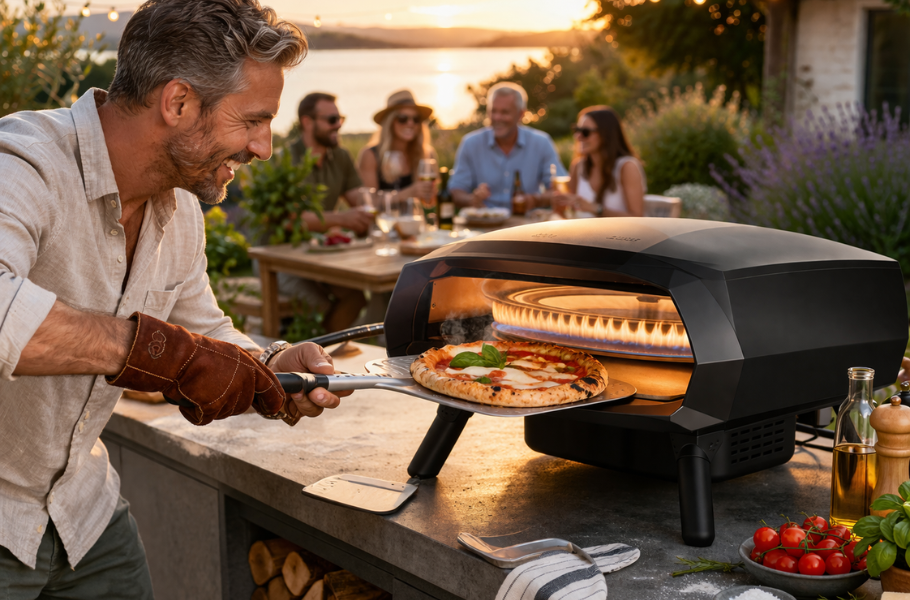
What they are & how they work: Gas pizza ovens connect to a standard patio gas bottle (Propane). You turn a dial, ignite the burner, and let the stone heat up.
Pros:
- Fast heat-up (10–20 minutes).
- Precise temperature control.
- Low effort and zero ash to clean up.
Cons:
- Slightly less smoky flavour.
- Requires a gas supply and somewhere to store the bottle.
🔥 Product examples:
- Firebloom GP01 Gas Pizza Oven: A strong entry-level option that hits 400°C and cooks a pizza in 90–120 seconds. Perfect for small patios.
- Witt Etna Rotante 16-inch: A premium gas option featuring a U-shaped burner and a rotating pizza stone for perfectly even cooking without having to manually turn the pizza.
✅ Best for: Beginners, weeknight use, and people who want consistency without the fuss.
👉 Want easy and convenient outdoor cooking? Browse all gas-fired pizza ovens here.
Wood-Fired Pizza Ovens Explained

What they are & how they work: The traditional choice. You build a fire in the back or side of the oven using kiln-dried hardwood, allowing the flames to roll over the dome and heat the stone.
💡 Worth knowing: You don’t have to be a lumberjack – you can easily buy pre-chopped, kiln-dried wood designed specifically for pizza ovens to save time and effort!
Pros:
- Authentic, wood-fired flavour.
- Incredibly high peak temperatures.
- The “Experience” factor – tending the fire is half the fun.
Cons:
- Longer heat-up times.
- More skill required to manage the fire and turn the pizza.
- More mess (ash clearance).
🔥 Product examples:
- Morso Forno Outdoor Oven: A stunning cast-iron centrepiece that doubles as an outdoor heater and grill. A standout option within the Morso outdoor range.
- Royal Wood Fired Pizza Oven: A freestanding, traditional-style oven that brings the ultimate authentic Italian pizzeria feel to your garden.
- DeliVita Wood Fired Outdoor Oven: A beautifully handcrafted, table-top wood-fired oven available in striking colours like Jubilee Blue and Chilli Red. Explore more from DeliVita pizza ovens.
✅ Best for: Entertaining, weekend cooking, and culinary enthusiasts who enjoy the process.
👉 Love the idea of wood-fired pizza? Take a look at our range of wood-fired pizza ovens or get kiln-dried wood for pizza ovens here.
Dual-Fuel Pizza Ovens Explained

What they are & how they work: These hybrid ovens (sometimes called multi-fuel ovens) give you the best of both worlds. You can use a gas burner for quick weeknight dinners, or switch to wood when you have more time on the weekend.
Pros:
- Ultimate flexibility (gas + wood)
- Can switch depending on the situation or weather.
Cons:
- Slightly more expensive due to the dual mechanisms.
- Can be overkill if you end up only ever using one fuel type.
🔥 Product examples:
- Fontana Margherita Hybrid Gas or Wood Fired Pizza Oven: A premium, Italian-made freestanding oven that lets you seamlessly switch between authentic wood-fired cooking and convenient gas.
- Delivita Chef Plus Dual-Fuel Oven: A high-end, beautifully designed oven that offers professional-grade dual-fuel capabilities.
✅ Best for: People who want both convenience and flavour, and those who love entertaining but also want quick family meals.
👉 Want the best of both worlds? Explore dual-fuel pizza ovens here.
Gas vs Wood vs Dual-Fuel: Side-by-Side Comparison
| Feature | Gas | Wood | Dual-Fuel / Hybrid |
|---|---|---|---|
| Ease of Use | ⭐⭐⭐⭐⭐ | ⭐⭐⭐ | ⭐⭐⭐⭐ |
| Heat-Up Time | Fast | Slow | Medium |
| Flavour | Good | Excellent | Excellent |
| Control | Precise | Variable | Flexible |
| Maintenance | Low | High | Medium |
| Price Range | £ | ££ | £££ |
| Best For | Beginners, regular use | Enthusiasts, entertaining | Mixed use, flexibility |
👉 Want to explore each type in more detail? Browse our full pizza oven range to find the right one for your space.
Which Pizza Oven Is Best for You?
- Choose gas if: You want quick, no-fuss cooking and plan to use it regularly after work.
- Choose wood if: You care deeply about authenticity, love the romance of a real fire, and enjoy the cooking process as an event.
- Choose dual-fuel if: You genuinely want both options and have the budget to invest in a hybrid model.
Common Myths About Pizza Ovens
- “Wood-fired always tastes better” → Slightly, but because a Neapolitan pizza cooks in just 60–90 seconds, it doesn’t absorb as much smoke as slow-smoked BBQ. Technique and dough quality matter more!
- “Gas ovens aren’t authentic” → Modern gas pizza ovens easily hit the 400–500°C required for an authentic Neapolitan rise and leopard-spotting.
- “You need a big garden” → Not true. Portable, table-top ovens like the Firebloom or Witt Piccolo fit perfectly on small balconies or courtyards.
Costs & Running
- Gas: A standard patio gas bottle costs around £35–£45 to refill and will last for dozens of pizza sessions. It’s highly economical.
- Wood: Kiln-dried hardwood logs or pellets are relatively cheap, but you will use a fair amount getting a large stone up to temperature. Pre-chopped pizza oven wood boxes usually run about £15–£25, though buying in bulk can work out better value if you cook often.
- Hidden Costs: Don’t forget to budget for essential accessories like a good quality pizza peel, an infrared thermometer, and a weatherproof cover.
Do You Actually Need a Pizza Oven?

Be realistic about how often you’ll use it. If you only make pizza once or twice a year, a pizza stone in your kitchen oven or on your BBQ may be enough. In that case, it’s worth exploring alternatives like our range of BBQs, which can still deliver great results with the right setup.
However, if you love hosting, want to get the kids involved in cooking, or are chasing that perfect crust a domestic oven simply can’t achieve, a dedicated pizza oven is a serious upgrade.
👉 Unsure which route to take? Our pizza oven buying guide breaks down the key differences, sizes, and features in more detail to help you make the right choice.
How Often Will You Actually Use It? (Real-World Insight)
- Most people use their pizza oven heavily for the first 2–3 months, then settle into a more occasional weekend routine
- Gas ovens tend to get used more consistently thanks to their speed and simplicity
- Wood-fired ovens are used more intentionally — usually for hosting and special occasions
- Dual-fuel oven users often default to gas for convenience, with wood used when there’s time to enjoy the process
💡 Worth knowing: Gas fits everyday cooking. Wood turns it into an experience.
Pizza Oven FAQs
Buying a Pizza Oven
What’s the best pizza oven in the UK?
The best pizza oven depends on your needs, but standout options include the gas-powered Witt Etna Rotante for consistent, even cooking, and the Morso Forno for a premium wood-fired experience that also doubles as an outdoor heater.
What is the best pizza oven for beginners?
A gas-powered table-top oven, like the Firebloom GP01, is the best starting point. Gas ovens heat up quickly, offer precise temperature control, and require no fire management.
What is a multi-fuel pizza oven?
A multi-fuel (or dual-fuel) pizza oven allows you to switch between gas and wood. This gives you the flexibility to cook quickly with gas or use wood for a more traditional, smoky flavour.
Are dual-fuel pizza ovens worth it?
Yes, if you’ll genuinely use both fuel types. If you expect to rely on gas most of the time, a dedicated gas oven is usually better value.
What is the best dual fuel pizza oven?
The best dual fuel pizza oven is the DeliVita Chef Plus Dual-Fuel Oven or the Fontana Margherita Hybrid. Both offer professional-grade insulation, exceptional build quality, and the flexibility to switch seamlessly between gas convenience and authentic wood-fired cooking.
What to know before buying a pizza oven?
Key things to consider include fuel type (gas for convenience, wood for flavour), heat-up time, available space, and whether you want a portable or freestanding model. Accessories like pizza peels and covers should also be factored in.
Is it worth having a pizza oven?
Yes, if you enjoy outdoor cooking and want authentic results. Standard home ovens cannot reach the 400°C+ needed for true Neapolitan-style pizza.
Using a Pizza Oven (Cooking, Costs & Practical Questions)
Do gas pizza ovens taste different?
Slightly. Gas ovens don’t produce the same smoky aroma as wood-fired cooking, but they still achieve the high temperatures needed for authentic crust and texture.
Are wood-fired pizzas healthier?
They can be, depending on the ingredients and cooking method. High temperatures cook pizzas quickly, helping retain nutrients, and traditional dough recipes are often simpler and less processed.
How hot should a pizza oven be?
For Neapolitan pizza, the stone should be around 400°C to 450°C.
Can you use a pizza oven in winter in the UK?
Yes. Pizza ovens work year-round, and wood-fired models can double as a heat source. Just use a weatherproof cover when not in use.
What can you cook in a pizza oven that isn’t pizza?
Pizza ovens are versatile – you can cook meats, vegetables, flatbreads, fish, and even desserts using cast iron cookware. Read our guide to what you can cook in a pizza oven here.
Can you cook jacket potatoes in a pizza oven?
Yes. Wrap them in foil and cook near the embers in a wood-fired oven, or bake them in a dish as the oven cools.
Can you cook burgers and sausages in a pizza oven?
Yes. Use a cast-iron pan or griddle to cook meats at a high heat for a quick sear and strong flavour.
Our Final Verdict
- Most people → Gas is the easiest win. It’s simple, fast, and guarantees great results.
- Enthusiasts → Wood delivers the full experience. Nothing beats the charm and extreme heat of a real fire.
- Tinkerers → Dual-fuel gives you flexibility. Switch between fuel types depending on your mood, energy level, or the occasion.
Ready to upgrade your outdoor cooking game?
Explore our full range of Outdoor Pizza Ovens and Table-Top Pizza Ovens at Direct Stoves today to find your perfect match.
More outdoor cooking guides
- 👉 Ideas for fun outdoor cooking with kids
- 👉 Gas BBQ buying guide
- 👉 Pizza oven buying guide
- 👉 Pizza oven cooking tips
Need Expert Advice?
- 📍 Visit us: Come and see outdoor cooking setups in person at our showroom.
- 📧 Get in touch: Unsure which type of pizza oven will work for you? Contact our team for friendly, expert advice.
↑ Back to top | Jump to sections ↑